Handpan Patterns for Beginners: Your First Steps
 Learn handpan patterns that sound musical from the start
You’ve got a handpan. You’ve struck a few notes. They sound beautiful - but you’re not sure what to do next.
Random tapping produces pleasant sounds, but it doesn’t feel like music. What you need are patterns - repeatable sequences that give structure to your playing and sound intentionally musical.
The good news: handpan patterns are easier to learn than you might think. You don’t need music theory or years of practice. A few simple patterns can transform aimless exploration into genuine music-making.
What Is a Handpan Pattern?
A pattern is simply a sequence of notes played in a specific order, usually repeated. Think of it as a small musical phrase you can loop.
On a handpan, patterns typically involve:
- The ding (center note) as an anchor
- Tone fields around the edge played in sequence
- A rhythmic structure that repeats
The beauty of patterns is that they’re self-contained. Learn one, and you have something complete to play. String several together, and you’re building a composition.
Understanding Your Handpan’s Layout
Before diving into patterns, know your instrument.
The Ding
The center of your handpan - usually the lowest note and the foundation of most patterns. It provides a bass anchor, like the root note of a chord.
The Tone Fields
The notes arranged around the ding. On a typical 9-note handpan, you have 8 tone fields in a specific scale.
The Numbering System
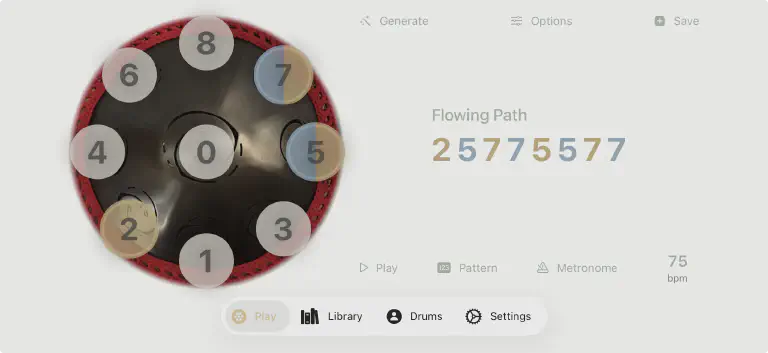
Most patterns use numbers to identify notes:
- 1 = The ding (center)
- 2-9 = Tone fields, typically numbered clockwise from the lowest
Knowing this numbering lets you follow any written pattern, regardless of which scale your handpan uses.
Your First Pattern: The Simple Arpeggio
Start here. This pattern works on any handpan.
Pattern: 1 - 2 - 3 - 4 - 5 - 4 - 3 - 2 (repeat)
Play each note evenly, letting them ring. You’re moving up through the scale, then back down - a simple wave motion.
What makes it work:
- The ding grounds the phrase
- The ascending/descending motion creates natural flow
- Repetition makes it meditative
Practice this until it feels automatic. Speed doesn’t matter - consistency does.
The Foundation Pattern
This pattern establishes a rhythmic foundation using the ding and lower notes.
Pattern: 1 - 2 - 1 - 3 - 1 - 2 - 1 - 4
Notice how the ding (1) appears between each new note. This creates a steady pulse while introducing melodic movement.
Tips:
- Keep the ding strikes consistent in volume
- Let the higher notes (2, 3, 4) ring slightly longer
- Try different tempos - slow feels meditative, faster feels energetic
Building Patterns: The Three Elements
Most good handpan patterns share three elements:
1. An Anchor
Usually the ding or a low tone field. The anchor is the note you return to, the home base of your pattern.
2. Movement
The notes that create melody. These move through your scale, building tension or release.
3. Rhythm
The timing of your strikes. Even simple rhythms - all even notes, or alternating long and short - transform random notes into music.
When you understand these elements, you can start creating your own patterns.
Intermediate Pattern: The Call and Response
This pattern uses two distinct phrases that “answer” each other.
Call: 1 - 3 - 5 - 7 Response: 8 - 6 - 4 - 2
Play the call, then the response. It creates a musical conversation - question and answer, tension and resolution.
Variations:
- Play the call twice before the response
- Add the ding between sections as a bridge
- Vary the rhythm - quick call, slow response
Rhythmic Patterns: Beyond Even Notes
Once you’re comfortable with basic sequences, rhythm becomes your next tool.
The Triplet Feel
Instead of even notes, group them in threes:
Pattern: 1-2-3 | 1-4-5 | 1-6-7 | 1-8-9
Each group of three notes flows together, creating a rolling, circular feel common in handpan music.
Emphasis on the Ding
In this pattern, the ding gets more weight:
Pattern: 1 - 3 - 4 - 1 - 5 - 6 - 1 - 7 - 8
Strike the ding slightly harder. It creates a heartbeat pulse underneath the melody.
Common Beginner Mistakes
Playing Too Fast
Speed feels impressive but hides poor technique. Slow practice builds muscle memory that sticks. Fast practice reinforces mistakes.
Hitting Too Hard
Handpans respond to gentle touch. Hard strikes produce harsh, short tones. Light, controlled strikes create warm, sustaining sounds.
Ignoring the Ding
The ding is your foundation. Beginners often focus on the tone fields because they’re more “melodic.” But the ding gives your patterns weight and grounding. Include it frequently.
Not Repeating Enough
A pattern needs repetition to become music. Playing a sequence once, then moving to something else, sounds random. Loop your patterns until they groove.
Finding New Patterns
Once you’ve mastered the basics, you’ll want more.
Listen to Other Players
YouTube is full of handpan performances. Don’t just enjoy them - watch carefully. Many players use simple patterns repeated and varied. Try to identify the sequences they’re using.
Use Pattern Generators
Apps like DrumFlow can generate patterns for you algorithmically. Instead of copying other players, you get fresh ideas tailored to handpan. Generate patterns, find ones that resonate, learn them.
Generate Patterns Instantly
DrumFlow creates musical handpan patterns you can practice anywhere. Free for iPhone and iPad.

Transpose What You Know
Take a pattern you’ve learned and shift it. If you played 1-2-3-4, try 1-3-5-7 (skipping notes) or 1-4-7-2 (larger intervals). Same rhythm, different notes - new pattern.
Follow Your Hands
Sometimes the best patterns emerge by accident. You’re noodling, and suddenly something sounds good. Stop. Figure out what you just played. That’s your new pattern.
Practice Framework for Beginners
Structure beats random practice. Here’s a simple framework:
Week 1-2: The Simple Arpeggio
Focus on one pattern. Play it slowly, evenly, repeatedly. Build consistency before speed.
Week 3-4: Add the Foundation Pattern
Now you have two patterns. Practice switching between them smoothly.
Week 5-6: Call and Response
Add musical phrasing. Practice the conversation between patterns.
Week 7+: Rhythm Variations
Apply different rhythms to patterns you know. Same notes, different feel.
This progression builds on itself. Each new skill assumes the previous one is solid.
When Patterns Start Sounding Like Music
There’s a moment - maybe a few weeks in - when something shifts. You’re not thinking about the next note anymore. Your hands know the pattern. You’re listening instead of counting.
That’s when handpan playing becomes musical.
Patterns are the path to that moment. They give your hands something reliable to do while your mind develops musicality. Once the patterns are automatic, you can focus on dynamics, expression, and flow.
Using a Simulator for Pattern Practice
You can’t always practice on your handpan. It’s late, you’re traveling, or the instrument isn’t nearby.
A handpan simulator lets you:
- Learn patterns anywhere - Practice the sequence without the instrument
- Build muscle memory - Your brain still encodes the pattern even on a screen
- Discover new ideas - Generate or experiment without pressure
- Prepare for real practice - Arrive at your handpan knowing what you want to work on
Simulators don’t replace real practice, but they extend it. Every minute you spend learning a pattern - on screen or metal - is a minute closer to mastery.
Common Questions
How long does it take to learn a handpan pattern?
A simple pattern can be learned in minutes. Making it feel natural takes a few days of consistent practice. True mastery, where the pattern flows without thought, takes weeks.
How many patterns should a beginner learn?
Start with three to five core patterns. Depth beats breadth - knowing five patterns well serves you better than knowing twenty patterns poorly.
Should I learn patterns or make up my own?
Both. Learning established patterns teaches you what works. Making your own builds creativity. Start with learning, then graduate to creating.
Do I need to read music to learn handpan patterns?
No. Number-based patterns (1-2-3-4) work without any music theory. Most handpan players use numbers rather than traditional notation.
What if a pattern doesn't sound good on my handpan?
Different scales suit different patterns. A pattern that sounds great in D Kurd might not work in Hijaz. Experiment, and don't force patterns that don't fit your scale.
Start Playing Today
Patterns transform handpan playing from random exploration into intentional music. They give your hands direction and your practice purpose.
You don’t need complicated sequences or advanced technique. The simple arpeggio - 1, 2, 3, 4, 5, 4, 3, 2 - is enough to start. Master that, add another pattern, then another. Build your vocabulary one sequence at a time.
Your handpan already makes beautiful sounds. Patterns help you arrange those sounds into something that feels like music.
Pick one pattern. Start practicing. Your hands will figure out the rest.
Ready to Find Your Flow?
Practice handpan patterns anywhere. Free on iPhone and iPad.