Tongue Drum Tutorial for Beginners: Your Complete Guide
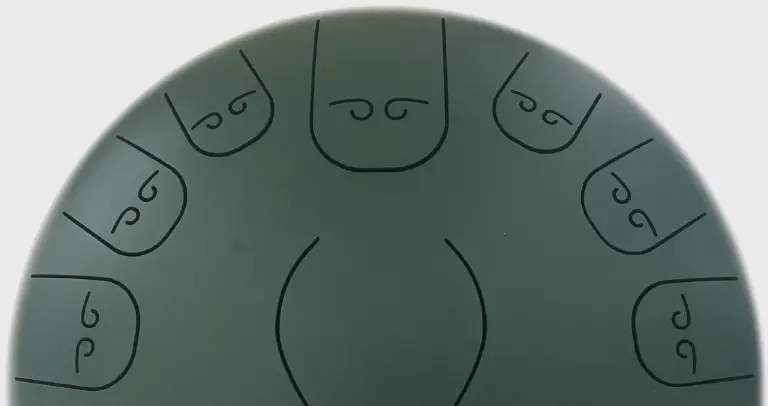 Learn tongue drum with simple numbered patterns
You’ve just got a tongue drum. The steel tongues gleam, promising beautiful sounds. You tap one - a warm, resonant tone fills the room.
But now what? How do you turn random tapping into actual music?
Good news: the tongue drum is one of the most beginner-friendly instruments you can learn. Unlike guitar or piano, there are no wrong notes. The pentatonic tuning means everything sounds harmonious together.
This guide takes you from first touch to playing real patterns. No music theory required - just a drum and the willingness to practice.
What Is a Tongue Drum?
A tongue drum (also called steel tongue drum, tank drum, or hank drum) is a percussion instrument made from steel with cut “tongues” that produce different notes when struck.
Unlike traditional drums that make noise, tongue drums create melodic, sustained tones. Each tongue is tuned to a specific pitch, arranged in a scale.
What Makes It Special
Pentatonic tuning - Most tongue drums use pentatonic scales (five notes per octave). Every note sounds good with every other note. You literally cannot play a wrong combination.
Intuitive layout - Notes are arranged so your hands naturally fall on harmonious patterns. The physical design guides you toward good-sounding music.
Forgiving technique - Unlike handpan or other percussion, tongue drums don’t require precise striking technique to sound good. A gentle tap produces a clear tone.
Getting Started: Position and Posture
Before playing your first note, set yourself up for success.
Sitting Position
Place the drum in your lap while sitting in a comfortable chair. Position it in the center - not too close to your body, or reaching the far tongues becomes awkward.
If sitting on the floor, cross your legs and rest the drum on top. Tilt it slightly toward you for easier access to all notes.
Hand Position
Rest your hands naturally on the drum’s surface. Your fingers should curve slightly, relaxed but ready. Tension is the enemy of good tone.
Keep your wrists loose. The striking motion comes from the wrist, not the elbow or shoulder.
Playing Technique: Hands vs. Mallets
You have two options for playing: your fingers or the mallets that came with your drum.
Playing with Mallets
Mallets are the easiest way to start. They produce a clear, consistent tone with minimal effort.
How to hold them: Grip lightly, like holding a pencil. Let the mallet bounce naturally off the tongue after striking.
Where to strike: Aim for the center-top of each tongue. This produces the clearest, most resonant tone.
Common mistake: Pressing the mallet into the tongue instead of letting it bounce. The mallet should rebound immediately, like a drumstick.
Playing with Hands
Hand playing offers more expression but requires practice.
Use your finger pads: Strike with the soft pad of your finger, not the fingertip. Think of the motion as a quick tap, like touching something hot.
Let your fingers bounce: Don’t press into the tongue. Strike and immediately lift, letting the note ring.
Start with larger tongues: The bigger tongues are more forgiving. Once your technique is solid, move to smaller notes.
Most players take a few days to develop consistent hand technique. Be patient - the expressive control is worth the practice.
Understanding Tongue Drum Notation
Forget about reading traditional sheet music. Tongue drum uses a simple numbered system that anyone can learn in minutes.
The Number System
Each tongue on your drum is assigned a number:
- 1 = The lowest (usually largest) tongue
- 2, 3, 4… = Higher notes in ascending order
- The highest number = The highest pitched tongue
A pattern written as “1 - 3 - 5 - 3” means: play the lowest note, skip to the third, jump to the fifth, return to the third.
Reading Patterns
Patterns are written as sequences of numbers, sometimes with timing indicators:
Simple sequence: 1 - 2 - 3 - 4 - 5 Play each note in order, evenly spaced.
Repeated notes: 1 - 1 - 3 - 3 - 5 Some notes appear twice for rhythmic emphasis.
Grouped notes: (1-3) - 5 - (1-3) - 6 Notes in parentheses are played together or in quick succession.
This numbered approach means you can follow any pattern regardless of which scale your drum uses.
Your First Patterns
Time to make music. These patterns work on any tongue drum.
Pattern 1: The Simple Scale
Pattern: 1 - 2 - 3 - 4 - 5 - 4 - 3 - 2 (repeat)
Start at the lowest note, climb up to 5, then descend. This ascending/descending motion creates a natural, flowing sound.
Practice tips:
- Play slowly and evenly
- Let each note ring before playing the next
- Focus on consistent volume across all notes
Pattern 2: The Anchor Pattern
Pattern: 1 - 3 - 1 - 4 - 1 - 5 - 1 - 4
The lowest note (1) acts as an anchor between melodic notes. This creates a grounded, rhythmic feel.
Practice tips:
- Keep the anchor note (1) consistent
- Let the higher notes sing slightly longer
- Try varying the tempo
Pattern 3: The Skip Pattern
Pattern: 1 - 3 - 5 - 3 - 1 - 4 - 6 - 4
Instead of playing adjacent notes, skip every other one. This creates wider intervals and a more melodic sound.
Practice tips:
- The wider jumps require more precision
- Practice the hand movement between distant tongues
- Speed comes after accuracy
Pattern 4: The Rolling Triplet
Pattern: 1-2-3 | 1-3-4 | 1-4-5 | 1-5-6
Group notes in threes, with the first note of each group being your anchor. This creates a rolling, meditative feel common in tongue drum music.
Practice tips:
- Each group of three should flow together
- Brief pause between groups
- The rhythm is: quick-quick-quick, pause, quick-quick-quick, pause
Building Your Own Patterns
Once you’ve mastered the basics, creating your own patterns is straightforward.
The Three Elements
Every good pattern has:
- An anchor - A note you return to regularly (usually note 1)
- Movement - Notes that create melody by moving up or down the scale
- Rhythm - A repeating timing structure
Simple Pattern Formula
Start with this template:
- Anchor note
- Two or three melodic notes
- Return to anchor
- Repeat with slight variation
Example: 1 - 3 - 5 - 1 - 4 - 6 - 1 - 5 - 3
Finding What Works
Not every pattern sounds good on every drum. Your scale affects which combinations feel musical. Experiment freely - the pentatonic tuning means nothing will sound bad, just some combinations will sound better.
Generate Tongue Drum Patterns
DrumFlow creates endless musical patterns for your tongue drum. Practice anywhere on iPhone and iPad.

Common Beginner Mistakes
Striking Too Hard
Tongue drums respond to gentle touch. Hard strikes produce harsh, metallic tones and can cause adjacent tongues to vibrate sympathetically (creating unwanted sounds).
Light, controlled taps create warm, sustained notes. Less force, more music.
Moving Too Fast
Speed feels impressive but hides poor technique. Slow practice builds the muscle memory that enables fast playing later.
If you can’t play a pattern perfectly at slow speed, you can’t really play it at all.
Ignoring the Low Notes
Beginners often gravitate toward higher, “brighter” notes. But the lower tongues provide grounding and depth. Include your anchor note (1) frequently.
Not Letting Notes Ring
Each tongue can sustain for several seconds. Cutting notes short by playing the next one too quickly loses the instrument’s beautiful resonance.
Leave space. Let notes breathe.
Practice Tips That Actually Work
Short Daily Sessions
Fifteen minutes every day beats two hours once a week. Your brain consolidates muscle memory during rest, not during practice. Consistent short sessions build skills faster.
Record Yourself
Your phone’s voice memo app is enough. Recording reveals problems you don’t notice while playing. It also tracks progress over time.
Practice Without the Drum
Mental rehearsal works. Visualize the pattern, imagine your fingers moving, hear the notes in your mind. This builds neural pathways even without the instrument.
Use a Simulator
When your drum isn’t available, a tongue drum app lets you:
- Learn new patterns anywhere
- Build muscle memory for finger positions
- Experiment without disturbing others
- Generate fresh ideas to try on your real drum
Apps like DrumFlow can generate patterns algorithmically, giving you endless material to practice rather than hunting for sheet music online.
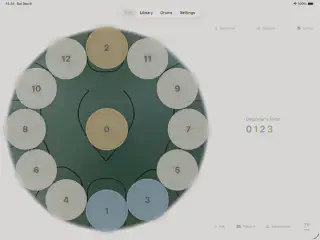
Practicing Anywhere with a Simulator
You can’t always have your tongue drum with you. A simulator app extends your practice time.
What Simulators Offer
- Accurate layouts matching real tongue drum arrangements
- Touch response that builds finger memory
- Pattern generation for endless practice material
- Silent practice for late nights or shared spaces
When to Use a Simulator
- Learning a new pattern before trying it on your real drum
- Traveling or commuting
- Late at night when volume matters
- Generating ideas to explore later
Simulators don’t replace your real instrument, but they multiply your practice opportunities. Every minute spent learning a pattern on screen translates to faster progress on metal.
What Comes Next
Once these basics feel comfortable, you’re ready to expand.
Dynamics
Same pattern, different volumes. Play some notes soft, others loud. This adds expression and emotion.
Rhythm Variations
Take a pattern you know and change its timing. Stretch some notes, compress others. Same notes, new feel.
Combining Patterns
String two patterns together. Use one as a verse, another as a chorus. You’re building compositions.
Chords
Strike two tongues simultaneously. Pentatonic tuning means most combinations sound harmonious. Experiment with which pairs resonate best on your drum.
Common Questions
Is tongue drum easy to learn?
Yes, tongue drum is one of the easiest instruments to learn. Most tongue drums use pentatonic scales, meaning every note sounds good together. You can create pleasant melodies within minutes of picking one up.
Should I use mallets or my hands to play tongue drum?
Both work well. Mallets give a clear, consistent sound and are easier for beginners. Hands offer more expression and dynamics but require practice to develop good technique. Start with mallets, then experiment with hands.
How long does it take to learn tongue drum?
You can play simple melodies in your first session. Basic technique takes a few days to feel natural. Learning to play expressively with dynamics and rhythm takes weeks of regular practice.
What size tongue drum should a beginner get?
An 8 to 12-inch drum with 8 to 11 notes is ideal for beginners. Smaller drums are more portable but have fewer notes. Larger drums offer more range but can be harder to handle.
Do I need to read music to play tongue drum?
No. Most tongue drum learning uses numbered notation where each tongue is assigned a number (1, 2, 3, etc.). This makes learning patterns simple without any music theory knowledge.
Can I practice tongue drum quietly?
Tongue drums are naturally quiet compared to other percussion. For silent practice, use a tongue drum simulator app on your phone or tablet. This lets you learn patterns and build muscle memory anywhere.
What scale should I choose for my first tongue drum?
C Major or D Major pentatonic scales are the most versatile for beginners. They sound pleasant, have many learning resources available, and work well for both meditative playing and upbeat melodies.
How often should I practice tongue drum?
Short daily sessions of 10 to 15 minutes are more effective than long occasional sessions. Consistency builds muscle memory faster than intensity. Even 5 minutes daily will show progress within weeks.
Start Playing Today
The tongue drum rewards you immediately. Unlike instruments that require months before you sound decent, your first session can produce genuinely beautiful music.
Start with the simple scale pattern. Play it slowly, evenly, repeatedly. When it feels natural, add the anchor pattern. Then the skip pattern.
Each pattern you master expands your vocabulary. String them together, vary the rhythm, add dynamics - suddenly you’re not just practicing, you’re playing.
Your tongue drum is waiting. Pick up those mallets (or use your fingers) and make your first sounds. The rest will follow.
Ready to Find Your Flow?
Practice handpan patterns anywhere. Free on iPhone and iPad.